Free Guide for Families

You Know the Math.
You Just Don't
Recognize the Page.

The homework is covered in boxes, branches and number lines, and none of it looks like the way you were taught. It's the same math. Here's the translation — your way on the left, their way on the right, and the one-line reason it changed.

1. Pick your child's grade

Free, no catch. You'll be added to our email list — unsubscribe in one click, any time. Privacy policy.

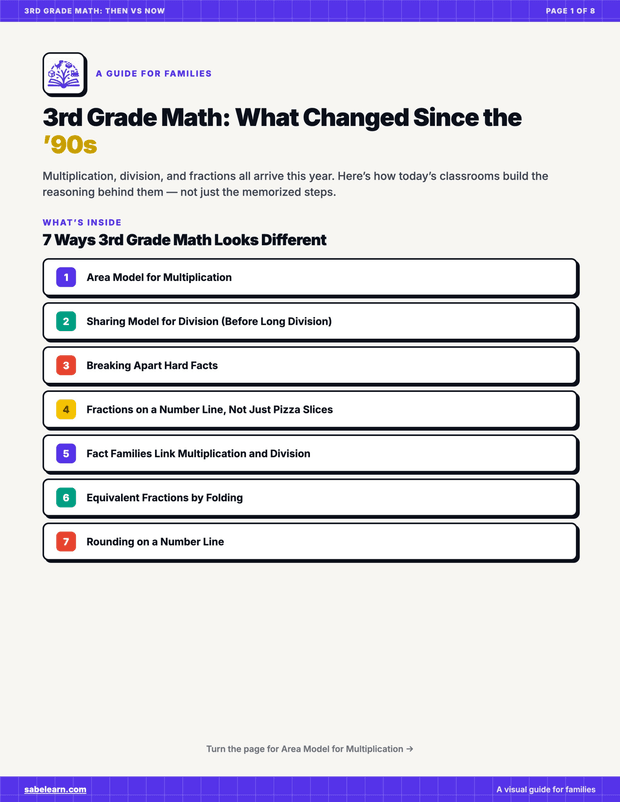
Cover of the 3rd Grade Math: Then vs Now family guide 8 pages · free PDF
What's Inside

Your way, their way, and why.

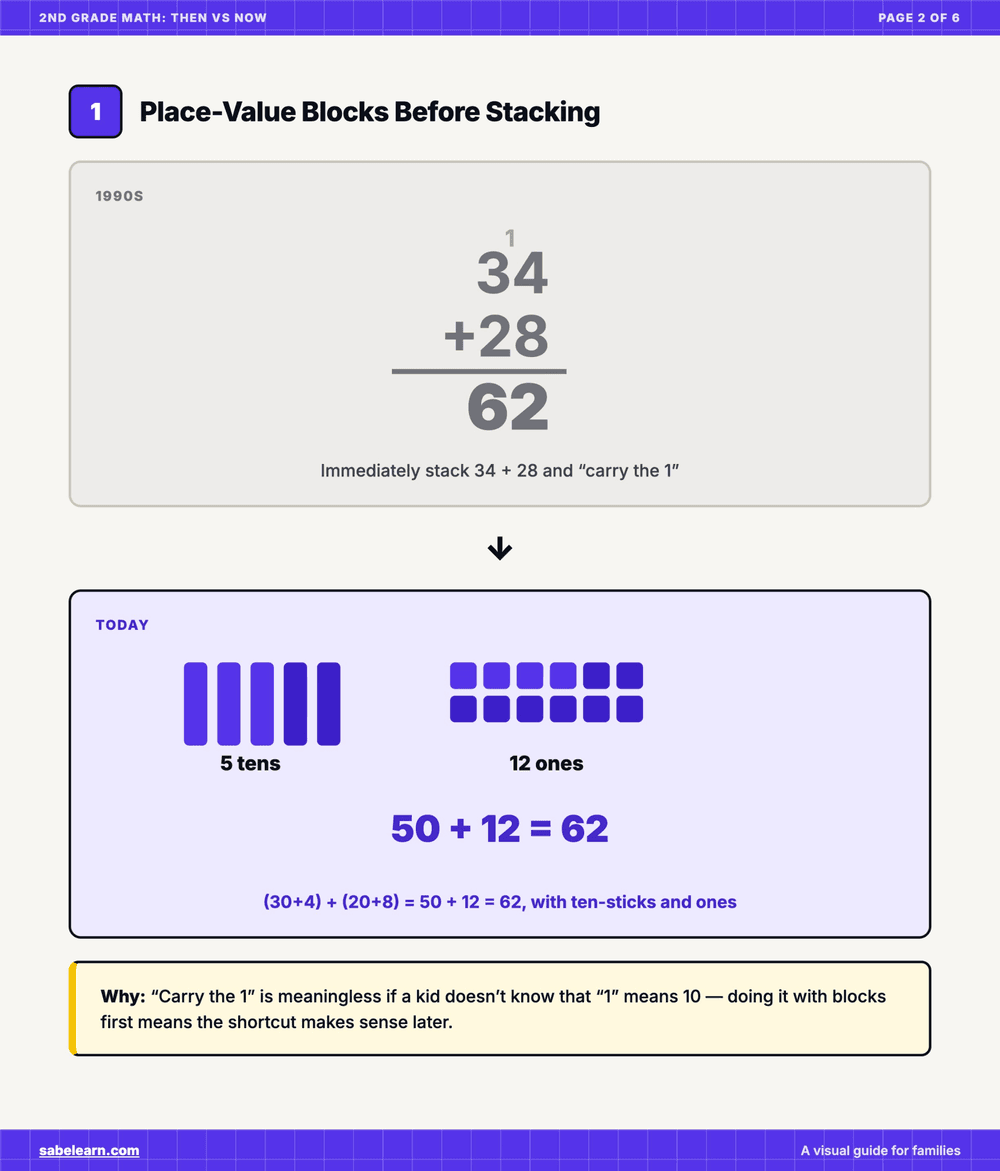
A page from the 2nd Grade guide: 34 + 28 stacked with a carried 1 above it, then the same sum built from five ten-sticks and twelve ones.

Page 2 of 6 · 2nd Grade Math: Then vs Now

Place-Value Blocks Before Stacking

2nd Grade · Topic 1 of 5

  • The gray boxHow you were taught it, back in the ’90s.
  • The purple boxThe exact same problem, the way your child is taught it today.
  • The yellow stripOne sentence on why the school made the swap.
Six Guides, One Per Grade

Your child’s year, topic by topic

Each guide covers only what shows up in that grade — nothing you don't need yet.

Kindergarten Math

8 pages · 6 topics

Counting and early number sense get a visual foundation — so "how many" becomes something your child sees, not something they recount every time.

  • Ten-Frames
  • Number Bonds
  • Counting by Groups
  • Comparing by Matching
  • Counting On
  • Shapes by Properties

1st Grade Math

7 pages · 6 topics

Addition and subtraction get a visual, hands-on foundation this year — and the guide shows why it pays off later.

  • Making a Ten
  • Number Lines for Add/Subtract
  • Word Problems by Situation, Not Keyword
  • Teen Numbers as "10 and More"
  • Missing-Addend Problems
  • Doubles and Near-Doubles

2nd Grade Math

6 pages · 5 topics

Place value, early multiplication ideas, and real data collection take center stage this year.

  • Place-Value Blocks Before Stacking
  • Arrays Preview Multiplication
  • Skip-Counting as a Real Tool
  • Odd/Even Through Pairing
  • Graphs Built From Real Data

3rd Grade Math

8 pages · 7 topics

Multiplication, division, and fractions all arrive at once — here is how the reasoning behind them gets built.

  • Area Model for Multiplication
  • Sharing Model for Division
  • Breaking Apart Hard Facts
  • Fractions on a Number Line
  • Fact Families Link × and ÷
  • Equivalent Fractions by Folding
  • Rounding on a Number Line

4th Grade Math

6 pages · 5 topics

Multi-digit multiplication, division, and fraction reasoning all get more sophisticated this year.

  • Box Method for Multi-Digit Multiplication
  • Partial Quotients for Division
  • Comparing Fractions with Benchmarks
  • Factors & Primes Through Building
  • Decimals as Another Way to Write Fractions

5th Grade Math

9 pages · 8 topics

The fast standard methods finally arrive — but only after years of models built the meaning behind them.

  • Standard Algorithms, Now Tied to Place Value
  • Fraction Multiplication with Overlapping Rectangles
  • Adding Fractions — the Picture Comes First
  • Dividing Fractions — Picture Before "Flip"
  • Decimal Operations Tied to Fractions
  • Order of Operations Through Real Situations
  • Volume Built With Real Unit Cubes
  • Coordinate Plane Introduced Earlier
Before You Ask

Questions parents actually have

Is this really free?

Yes. The guide costs nothing and there's no card, no trial and no upsell attached to it. We make money on workbooks and printed material; the games, the apps and this guide are free. All we ask for is your email address — we never sell it or share it with anyone — and you can unsubscribe the moment the guide lands if you want to.

My kid's in two different grades. Can I get both guides?

Yes — submit the form again with the other grade. Same email address is fine; you'll just get the second PDF in a separate message, and you won't be added to the list twice.

Is this Common Core specific? We're in Texas.

The methods are the same whether your state calls it Common Core, TEKS or SOLs. Ten-frames, number bonds, area models and partial quotients show up in every modern math program — the standards use different codes, the pictures on the homework look the same.

I don't want to confuse my kid by teaching it the old way.

That's exactly what the guide prevents. It isn't asking you to re-learn anything — it's showing you what you're looking at so you can help without the two of you ending up in an argument over whose method is right. Both methods get the same answer; the guide tells you why the school picked theirs.

Which grade should I pick if my child is between levels?

Pick the grade they're enrolled in. If they're working above or below it, grab the second guide too — it takes ten seconds and the overlap between neighboring grades is small.

Stop guessing at the homework.

Pick a grade, give us an email, and the guide is in your inbox before the next worksheet comes home.

Get my free guide